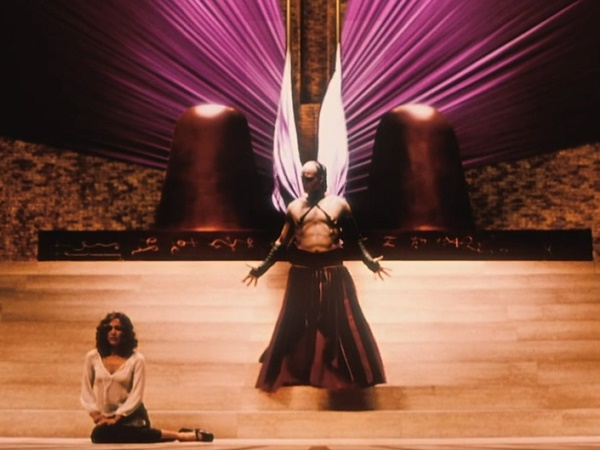
The Cell Short Story directed by Tarsem Singh (big-screen debut)
Starring Jennifer Lopez, Vincent D’Onofrio, Vince Vaughn, Jake Weber, James Gammon
Perhaps viewing intestines get reeled out of a live human’s belly via a medieval crank-and-shaft torture device falls too far on the gruesome side of the spectrum to wish to stick around for a warm-and-fuzzy message. For a tender moral to the story. But stick around you must because the message of unconditional compassion and love at the heart of Tarsem Singh’s, The Cell, is compelling and essential to digest.
It is rare that perpetrators of violence on innocent victims are extended empathy, compassion, or the chance at genuine redemption. The prison-industrial complex thrives on condemnation and penalization of criminals, judging most as hopeless social rejects much better off left to rot in cages. Code for society being much better off without these worthless blights on the community. Authentic reform in jail is the exception not the rule.
We love to judge criminals as incorrigibly “bad” — lambs to the slaughter as a counterpoint to elevate the perception of ourselves as “good.” Black or white thinking rules our consciousness, whether we know it or not. Duality runs the show on planet Earth, with human psyches caught in the pendulous sweep of things seeming categorically good or 100 percent bad. Thou shall not kill, steal, cheat, covet, etc. and if we do, we’re sinful, aka “bad.”
But don’t “good” people commit these “sins” all the time? OK, maybe not the mortal varieties of taking another’s life, or holding up banks, but certainly the kinder, gentler, venial ilk, like cheating and coveting. Cheating, in the sense of extramarital affairs, is almost a pastime to about one in four Americans. According to the Associated Press, 37 percent of men and 22 percent of women admit to infidelity. But are they “bad” people?
Maybe the same latitude can be extended to perpetrators of the more “heinous” variety of “sin,” such as murder. With the death penalty legal in 32 states and illegal in only 18, it seems we would rather not bother digging around to find a reason for such latitude.
What is so remarkable, subversive, enlightened and evolved about Tarsem Singh’s 2000 film, The Cell, is that the narrative doesn’t harp on throwing the book at pathological serial murderer, Carl Stargher, played with deft diabolical endearment, by Vincent D’Onofrio. While grotesque, surreal sequences whose cinematography would make Trent Reznor or Marilyn Manson jealous, illustrate the macabre inner consciousness of this psychopath, psychotherapist Catherine Deane, portrayed with tender seraphim mercy by Jennifer Lopez, is on a mission to save this fallen soul. Not to corroborate his evil nature, which “rational” minds have the penchant to label such individuals as possessing.
Although the premise that people who commit acts of violence have often been victims of violence themselves, is somewhat common knowledge, writer, Mark Protosevich’s rendering of this axiom is far from cliché or commonly delivered. It is five stars with a cherry on top. Or, rather, a bloody Mephistophelean calliope box with a chilling refrain of childlike innocent purity, on top. Stargher’s unspeakably brutal series of murders of young woman may be homicides his delusional altar ego cannot stop him from performing but the film gracefully exposes the even more unspeakably traumatized child underneath, who wants nothing more than to be saved from the possession of evil that has devoured his will. Through an experimental (and extremely risky therapeutic technique) Deane (Jennifer Lopez) is able to enter Stargher’s unconscious psyche and attempt to heal the profoundly broken child so far gone to madness inside him. She teams up with attorney turned FBI agent, Peter Novak, played even-handedly by Vince Vaughn, in time to save Stargher’s next victim. But maybe the Virgin-Mother-like compassion of Deane is enough to reach, and save, more than that.